
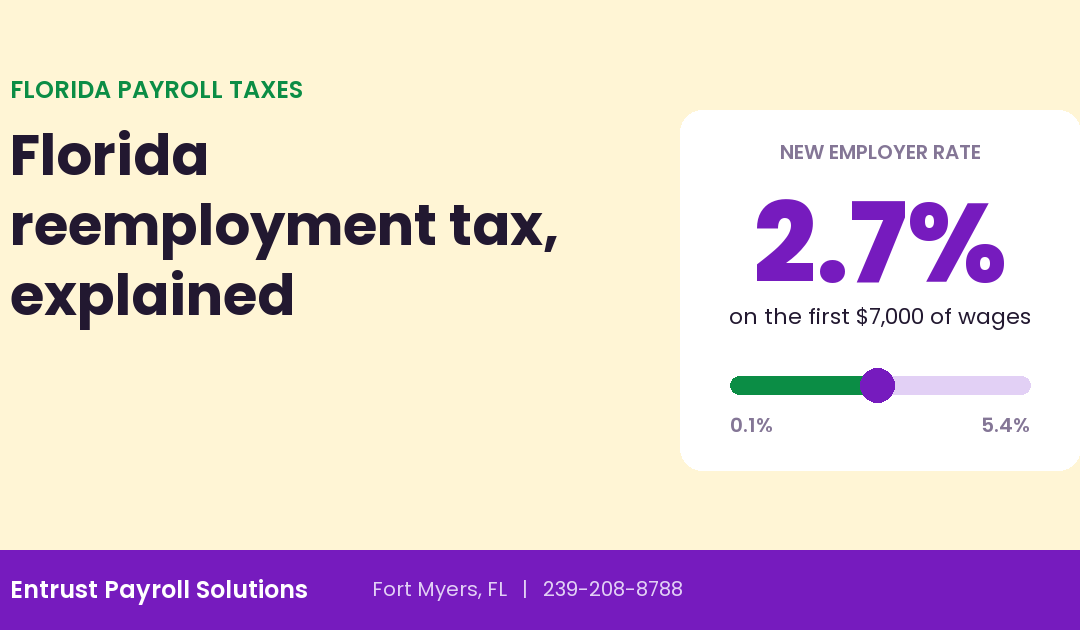
TL;DR: Florida reemployment tax is the state’s unemployment tax, paid by employers on the first $7,000 of each employee’s wages every year. New employers pay 2.7%, which is $189 per employee. After about 10 quarters, your rate is based on the benefits charged to your account and can range from 0.1% to 5.4%. Paying it on time also cuts your federal FUTA rate to 0.6%.
Florida has no state income tax, so a lot of new business owners assume there is no state payroll tax either. There is one: the Florida reemployment tax, which is what every other state calls unemployment tax. It is small per employee, it is easy to overlook, and the way your rate is set means your own layoff history decides what you pay. We covered the filing calendar in our guide to quarterly payroll tax deadlines in Florida. This post covers everything else: who owes it, what it costs and how to keep your rate low.
What is Florida reemployment tax?
Florida reemployment tax is the state unemployment tax Florida employers pay to fund Reemployment Assistance, the benefits paid to people who lose their jobs through no fault of their own. The Florida Department of Revenue collects it, and the money goes into the state’s Unemployment Compensation Trust Fund.
Florida renamed its unemployment program “Reemployment Assistance,” so the tax followed. If you see SUTA, SUI, Florida unemployment tax or reemployment tax, they all mean the same thing. It is an employer cost, paid on top of wages, and it is reported quarterly on Form RT-6.
Who has to pay Florida reemployment tax?
A Florida business becomes liable for reemployment tax once it pays at least $1,500 in wages in any calendar quarter, or employs at least one person for some part of a day in 20 different weeks in a calendar year. Once either test is met in the current or prior year, you must register and file every quarter.
Those two tests come from Florida Statute 443.1215, and they catch almost every business with a real payroll. A single part time employee earning $1,500 in a quarter is enough. Special rules apply to household employers, agricultural employers and nonprofits, so if you employ a nanny or run a church, check your situation separately. We handle household employee payroll and nonprofit and church payroll for exactly that reason.
Independent contractors do not count, which is one more reason classification matters. If the state later decides your “contractors” were employees, it can assess reemployment tax on the wages you paid them, and misclassified workers are a known trigger for reemployment tax audits. Our post on 1099 vs. W2 classification in Florida explains the test.
What is the Florida reemployment tax rate?
New Florida employers pay reemployment tax at an initial rate of 2.7% on the first $7,000 of each employee’s annual wages, or $189 per employee per year. After roughly 10 quarters of reporting, the state assigns a rate based on your own claims history, from a minimum of 0.1% ($7 per employee) to a maximum of 5.4% ($378 per employee).
Those figures come from the state’s own Florida reemployment tax guide for employers, published by Florida Commerce. Here is what they mean in dollars for a small business:
| Your rate | Tax per employee per year | 5 employees | 15 employees |
|---|---|---|---|
| 0.1% (minimum) | $7 | $35 | $105 |
| 2.7% (new employer) | $189 | $945 | $2,835 |
| 5.4% (maximum) | $378 | $1,890 | $5,670 |
The $7,000 wage base is per employee, per calendar year. Once an employee has earned $7,000 with you in a year, you stop paying reemployment tax on them until January. That is why the tax feels heavy in the first quarter and then disappears for your full time staff.
How your rate changes after the first 10 quarters
Once you have enough history, the Department of Revenue rates your account by dividing the benefits charged to it by your taxable payroll over the first 7 of the last 9 quarters. In plain terms: every former employee who collects Reemployment Assistance and is charged to your account pushes your rate up. A business with stable staff and few claims drifts toward the 0.1% floor. A business with frequent seasonal layoffs can end up near the top of the range.
Three habits keep your rate down:
- Hire carefully. Every departure is a potential claim. Our hiring and recruitment support exists because a bad hire costs you twice, once in training and again on your tax rate.
- Respond to every claim notice. When a former employee files, the state asks you for information. If the person quit voluntarily or was let go for misconduct, say so, with documentation. If you do not respond, the state decides without your side of the story.
- Document separations. A short written record of why someone left is what makes step two possible. Our HR services include help setting that up.
If you buy an existing business, you may be able to take over the previous owner’s rate, along with any unpaid balance. Look at that rate before you close.
How does reemployment tax affect your federal FUTA bill?
Paying Florida state unemployment tax on time lowers your federal unemployment tax. The federal FUTA rate is 6.0% on the first $7,000 of wages, but employers who pay their state unemployment tax in full and on time get a credit of up to 5.4%. That leaves an effective FUTA rate of 0.6%, or $42 per employee.
The IRS explains the credit in its Topic 759 on Form 940 and FUTA. The key words are “in full, by the due date.” If your RT-6 payments are late, you can lose part of that credit, and a $42 per employee federal bill can climb toward $420. For most small businesses, that credit is worth more than the Florida tax itself, which is the best argument for never paying RT-6 late. Our post on what happens if you run payroll late in Florida covers the rest of the penalty picture.
How do you file and pay Florida reemployment tax?
Florida employers report wages and pay reemployment tax each quarter on Form RT-6, filed with the Florida Department of Revenue. The RT-6 is due by the last day of the month after each quarter ends: April 30, July 31, October 31 and January 31.
The RT-6 lists every employee, their gross wages for the quarter and the taxable portion under the $7,000 base. You need an RT account number first, which you get by registering with the Department of Revenue once you meet either liability test. Register as soon as you meet either test, so your first RT-6 is not already late.
This is exactly the kind of recurring, detail heavy filing that gets missed during a busy quarter. When we run your payroll, payroll tax filings including the RT-6 are handled on our side, and your quarter end and year end reporting comes with it.
Frequently asked questions about Florida reemployment tax
Is Florida reemployment tax deducted from employee paychecks?
No. Florida reemployment tax is an employer tax. It is paid by the business on top of wages and is not withheld from employees’ pay.
How do I find my Florida reemployment tax rate?
Your rate is shown on the rate notice the Department of Revenue sends each year and in your account on the Department of Revenue’s reemployment tax website. New employers pay 2.7% until they have enough history to be rated.
What is the Florida reemployment tax wage base?
The wage base is $7,000 per employee per calendar year. You pay the tax only on the first $7,000 you pay each employee in a year.
Why am I paying unemployment tax in Florida?
Every employer that pays $1,500 in wages in a quarter, or has an employee in 20 different weeks of a year, is liable. The tax funds benefits for workers who lose their jobs, and paying it on time also earns your federal FUTA credit.
Take reemployment tax off your list
Reemployment tax is not complicated, but it is relentless: four filings a year, a rate that moves with your history, and a federal credit that depends on being on time. We are a local payroll company serving Southwest Florida, from Fort Myers to Cape Coral and Naples. Get a free quote or contact me at 239-208-8788.