
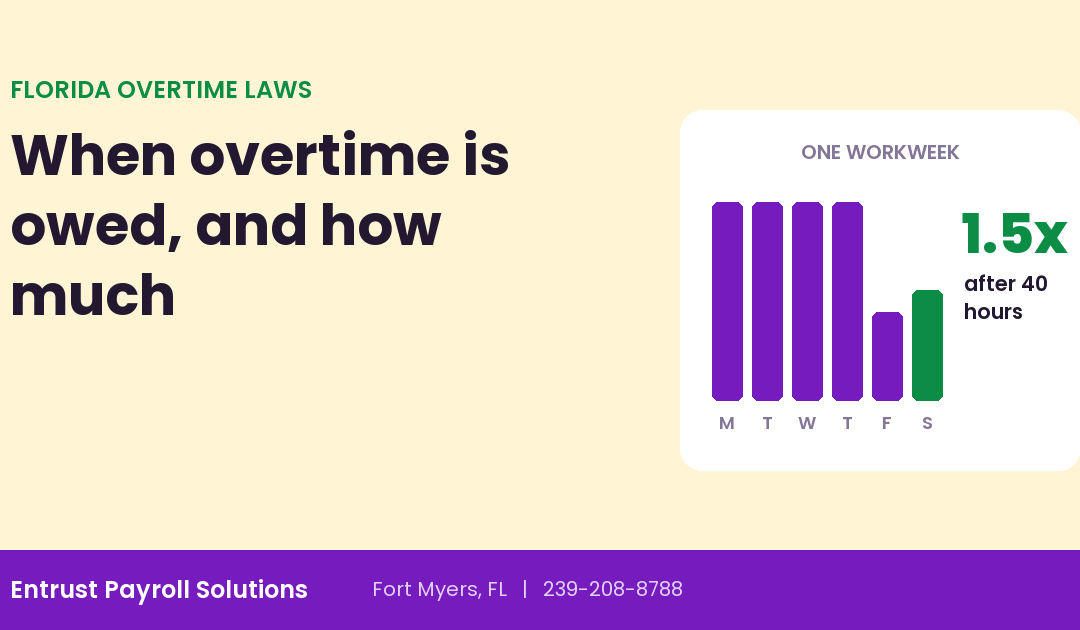
TL;DR: Florida overtime laws follow the federal Fair Labor Standards Act: non exempt employees earn time and a half for every hour over 40 in a workweek. There is no daily overtime and no weekend premium. At the new $15.00 minimum wage, overtime is at least $22.50 an hour. Exempt status needs a salary of at least $684 a week and the right job duties.
Overtime is where small business payroll goes wrong most quietly. Nobody gets a penalty notice the week a timesheet shows 43 hours at straight time. It shows up later, as a wage claim for every week that employee ever worked. Here is how overtime laws in Florida actually work, including one old state statute almost nobody mentions. If you would rather not track any of it, our payroll company in Fort Myers calculates overtime on every run.
Does Florida have its own overtime law?
Florida does not set its own overtime rate. Overtime for Florida employers comes from the federal Fair Labor Standards Act, which requires time and a half for hours over 40 in a workweek. Florida does have one older statute, Section 448.01, that treats 10 hours as a legal day’s work for manual laborers.
That statute is the answer to the “Florida overtime law 10 hours” question people search for. The statute says that when someone is employed to perform manual labor, 10 hours is a legal day’s work, and work beyond 10 hours in a day entitles them to “extra pay,” unless the employer and employee have signed a written contract setting different hours. It does not set a rate, and it does not replace the federal 40-hour rule.
Most overtime guides skip it entirely. If you have crews working days longer than 10 hours in construction, landscaping or manufacturing with no written agreement on hours, it is worth asking your employment attorney how it applies to you. A signed offer letter that states scheduled hours is a simple way to close the question. Our industrial and manufacturing payroll clients deal with this more than most.
When do employees earn overtime in Florida?
Non exempt employees in Florida earn overtime for every hour worked over 40 in a single workweek. The workweek is any fixed, recurring 168-hour period you choose, such as Sunday through Saturday. Each workweek stands alone, so you cannot average a heavy week against a light one.
The U.S. Department of Labor’s overtime guidance is clear on the points employers most often get wrong:
- No daily overtime. Federal law does not require overtime for a long day, only for a long week. A 12-hour Monday is straight time if the week totals 40 or less.
- No weekend or holiday premium. Saturdays, Sundays and holidays are ordinary hours unless they push the week over 40. Paying extra on holidays is a policy choice, not a legal requirement.
- No averaging. Averaging hours over two or more weeks is not permitted. Biweekly pay periods do not change this: you still count each week separately.
That last one is easy to get wrong on biweekly payroll. Eighty hours in two weeks sounds like no overtime, but 48 and 32 means eight hours of overtime in week one.
How to calculate overtime pay in Florida
Overtime pay in Florida is time and a half: the employee’s regular rate multiplied by one and a half for each hour over 40 in the workweek. For a minimum wage worker at $15.00 an hour, that is $22.50 per overtime hour. For someone earning $20.00 an hour, it is $30.00.
| Hourly rate | Overtime rate | Total pay, 40 regular plus 5 overtime hours |
|---|---|---|
| $15.00 (Florida minimum from September 30, 2026) | $22.50 | $712.50 |
| $18.00 | $27.00 | $855.00 |
| $22.00 | $33.00 | $1,045.00 |
The regular rate is not always just the hourly wage. Production bonuses, attendance bonuses and shift differentials generally have to be folded in before you multiply by 1.5. This is where do it yourself payroll most often underpays, because the bonus is paid on a different check and nobody goes back to recalculate the overtime.
Tipped employees add another layer. Overtime is based on the full minimum wage, not the tipped cash wage, which our guide to restaurant payroll in Fort Myers walks through with examples. For on call staff, see how payroll works for on call employees.
Who is exempt from overtime pay in Florida?
Employees are exempt from overtime in Florida only if they pass the federal tests. For the common executive, administrative and professional exemptions, that means a salary of at least $684 per week ($35,568 a year) plus job duties that match the exemption. A job title alone never makes someone exempt.
Three things have to be true at once: the employee is paid a fixed salary that does not drop when they work fewer hours, the salary is at least $684 a week, and their actual day to day duties fit the exemption. A “manager” who spends most of the day on the register usually fails the duties test.
Paying someone a salary does not make them exempt, either. A salaried non exempt employee still earns overtime, and still has to average at least the $15.00 minimum for every hour worked. Our post on exempt vs. non exempt classification has a three question test you can run on every salaried role.
Is mandatory overtime legal in Florida?
Yes. Mandatory overtime is legal in Florida for employees aged 16 and older. Federal law places no limit on the number of hours an adult can be required to work in a workweek, and Florida adds none. The only requirement is that non exempt employees are paid time and a half for the hours over 40.
An employee who refuses scheduled overtime can generally be disciplined, since Florida is an at will state. The exceptions come from other laws, such as FMLA leave or a union contract. Minors are different, with strict limits on hours under Florida’s child labor rules. If you set an overtime expectation, put it in writing in your handbook. Our HR services can help you draft that policy.
Is overtime taxed in Florida?
Florida has no state income tax, so there is no state tax on overtime. Overtime is still subject to federal income tax withholding. For 2025 through 2028, employees can deduct the premium part of their overtime pay on their federal return, up to $12,500 a year, or $25,000 for joint filers.
The IRS summary of the 2025 “no tax on overtime” deduction explains that it covers only the amount above the regular rate, the “half” in time and a half, and only overtime required by the Fair Labor Standards Act. The deduction phases out at higher incomes.
What changes for you as the employer is reporting, not withholding. Employers must now report the total qualified overtime paid during the year on the employee’s W-2. That makes accurate overtime tracking more important than ever, because the number your employee deducts comes straight from your payroll records. If your system does not separate the overtime premium today, fix that before year end. Our quarter end and year end payroll service handles the W-2 side for clients.
Frequently asked questions about Florida overtime laws
Is overtime after 8 hours or 40 hours in Florida?
Overtime in Florida is after 40 hours in a workweek, under the federal Fair Labor Standards Act overtime rules. There is no daily overtime rule under federal law, so an 8- or 10-hour day does not by itself trigger overtime pay.
How many hours straight can you legally work in Florida?
Florida and federal law set no limit on the hours an adult employee can work in a day or a week. Limits apply only to minors under 18.
Can an employer give comp time instead of overtime in Florida?
Private employers generally cannot replace overtime pay with comp time. Hours over 40 in a workweek must be paid at time and a half in that pay period.
Do salaried employees get overtime in Florida?
Only if they are non exempt. A salaried employee who earns less than $684 a week, or whose duties do not meet an exemption, is owed overtime for hours over 40.
Let us get your overtime right
Overtime mistakes rarely show up in one paycheck. They show up years later, multiplied. We are a local payroll team serving Cape Coral, Naples and all of Southwest Florida. Get a free quote or contact me at 239-208-8788.