
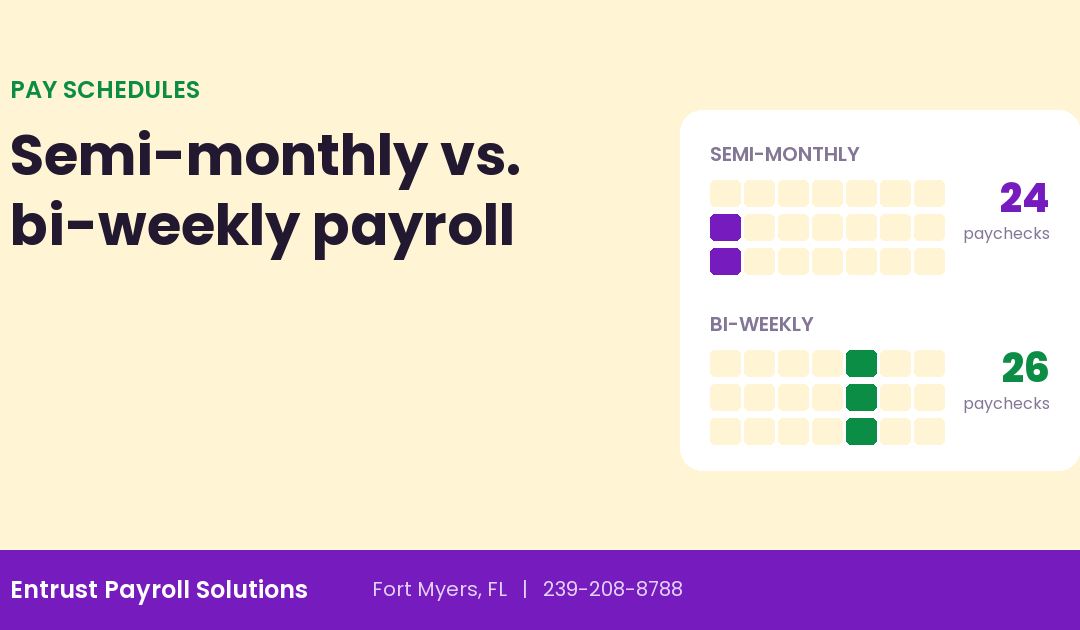
TL;DR: Semi monthly vs bi weekly comes down to 24 paychecks or 26. Semi-monthly pays twice a month on fixed dates; bi-weekly pays every other week on the same weekday. Bi-weekly lines up with the 40-hour workweek, so overtime is simpler for hourly staff. Semi-monthly suits salaried teams and monthly bills. Florida law does not require either, so the choice is yours.
Pay frequency is one of the first decisions you make when you hire, and one of the hardest to change later without confusing people. The semi monthly vs bi weekly question sounds like a calendar detail, but it affects how you calculate overtime, how benefit deductions divide, and how many payroll runs you pay for each year. Here is how the two schedules actually differ, and how to pick. If you are setting up payroll for the first time, our guide to small business payroll in Fort Myers covers the rest of the setup.
What is semi-monthly pay?
Semi-monthly pay means employees are paid twice a month on two fixed dates, such as the 15th and the last day of the month, for 24 paychecks a year. When a payday falls on a weekend or holiday, most employers pay on the business day before. Each paycheck covers half a month.
A semi-monthly pay schedule keeps paydays predictable by date, which many employees like because rent and most bills are monthly. Salaried pay is easy: divide the annual salary by 24. The complication is hourly work. A half month runs fifteen or sixteen days depending on the month, and it never lines up neatly with a Sunday to Saturday workweek.
What is bi-weekly pay?
Bi-weekly pay means employees are paid every other week on the same weekday, usually a Friday, for 26 paychecks in most years. Each paycheck covers exactly two workweeks, two full 40-hour weeks for a full-time employee, which makes hourly payroll and overtime straightforward.
Because paydays fall on a fixed weekday rather than a fixed date, two months each year have three paydays instead of two. Employees tend to like those months. Budgeting for them is part of choosing this schedule, because your cash outflow is uneven across the year.
How many bi-weekly pay periods are in a year?
A bi-weekly schedule has 26 pay periods in most years, because a year holds fifty-two full weeks. Every so often a year contains 27 bi-weekly paydays, because a year is also one or two days longer than fifty-two weeks, and those extra days accumulate. Whether a given year has 27 depends on the date of your first payday.
The 27th payday matters most for salaried employees. If you pay a $52,000 salary as $2,000 every two weeks, a 27-payday year costs you $54,000 unless you plan for it. Some employers recalculate the per-check amount for that year; others simply pay the extra check. Decide in advance and put the rule in writing. A semi-monthly schedule never has this problem: it is always 24.
Semi-monthly vs. bi-weekly at a glance
| Semi-monthly | Bi-weekly | |
|---|---|---|
| Paychecks per year | 24 | 26 (occasionally 27) |
| Payday | Two fixed dates, e.g. 15th and last day | Same weekday every other week |
| $52,000 salary per check | $2,166.67 | $2,000.00 |
| Full-time hours per check | Varies, about 86.7 on average | 80 |
| Overtime calculation | Harder: workweeks split across pay periods | Easier: each period holds two whole workweeks |
| Three-paycheck months | Never | Two most years |
| Payroll runs per year | 24 | 26 |
How overtime works on each schedule
Overtime is where the semi monthly vs bi weekly choice really bites. Under federal law, overtime is owed for hours over 40 in a workweek, and the workweek is a fixed, recurring seven-day period. The U.S. Department of Labor is explicit that averaging hours over two or more weeks is not permitted, no matter how you schedule paydays.
On a bi-weekly schedule, every pay period contains exactly two whole workweeks, so you total each week, pay overtime on anything over 40, and you are done. On a semi-monthly schedule, a workweek often starts in one pay period and ends in the next. You still have to calculate overtime week by week, which means holding some hours until the week closes or correcting the next check. It is manageable with good software, but it is also where do-it-yourself payroll most often goes wrong.
That is why bi-weekly is the usual choice for businesses with mostly hourly staff: restaurants, retail, construction and field service. Our guide to Florida overtime laws walks through the full calculation, including bonuses and the new $15.00 minimum wage.
Does Florida require a specific pay frequency?
No. Florida has no state law setting how often employers must pay wages, and federal law does not set a pay frequency either. The U.S. Department of Labor lists Florida as having no payday regulations. Employers can choose weekly, bi-weekly, semi-monthly or monthly, as long as minimum wage and overtime are paid for every workweek.
The Department of Labor’s state payday requirements table shows Florida with “no regulations or not specified,” which puts it among a handful of states that leave pay frequency entirely to the employer. Many other states require at least semi-monthly pay, so if you have employees working outside Florida, check their state before you settle on a schedule.
Having no rule does not mean anything goes. Whatever schedule you pick, stick to it. A final paycheck is expected by the next regular payday, which our post on Florida final paycheck law explains, and late wages create federal minimum wage problems quickly.
How to choose the right pay schedule
The practical answer depends on who you employ:
- Mostly hourly staff: choose bi-weekly. Overtime is cleaner and timesheets map to pay periods.
- Mostly salaried staff: semi-monthly works well. Paychecks are identical every time and match monthly bills and benefit premiums.
- A mix: many businesses run everyone bi-weekly for simplicity. Running two schedules doubles the chances of a mistake.
- Tight cash flow: remember that bi-weekly means two three-paycheck months a year, and occasionally a 27th payday.
Benefit deductions also divide differently. A $240 monthly health premium becomes $120 per check on a semi-monthly schedule, but $110.77 per check on a bi-weekly one ($240 x 12 / 26), and it has to be set up that way from the start.
Can you switch from semi-monthly to bi-weekly?
You can change pay frequency in Florida, since no state law fixes it, but plan the transition carefully. Give employees written notice well ahead of the change, map out the transition pay period so nobody goes an unusually long stretch without pay, and recalculate salaried per-check amounts and benefit deductions.
The transition month is where problems hide: a short or long pay period, deductions taken twice or not at all, and overtime for a workweek that straddles the old and new schedules. If you are thinking about a change, it is a good time to talk to a payroll company in Fort Myers before you announce it, not after.
Frequently asked questions about semi-monthly vs. bi-weekly pay
Is twice a month bi-monthly or semi-monthly?
Twice a month is semi-monthly. Bi-monthly technically means every two months, although people often use it loosely to mean twice a month. In payroll, say semi-monthly for twice a month and bi-weekly for every other week to avoid confusion.
What are the cons of semi-monthly pay?
Semi-monthly pay makes hourly overtime harder, because workweeks do not line up with pay periods. Paydays also move around the week, landing on different weekdays each month. For salaried employees, those downsides mostly disappear.
Which pays more, semi-monthly or bi-weekly?
Neither pays more over a year. An employee’s annual pay is the same; it is simply divided into 24 or 26 checks. Each semi-monthly check is larger, but there are fewer of them. The exception is a 27-payday bi-weekly year if the per-check salary is not adjusted.
Is it normal to get paid semi-monthly?
Yes. Semi-monthly is a common schedule, especially for salaried and office staff. Bi-weekly is more common for hourly workforces because it aligns with the workweek used for overtime.
Let us run the schedule for you
Whichever schedule you choose, the hard part is running it the same way every time: overtime per workweek, deductions divided correctly, and paydays that never slip. We handle payroll for businesses across Cape Coral, Naples and all of Southwest Florida. Get a free quote or contact me at 239-208-8788.