
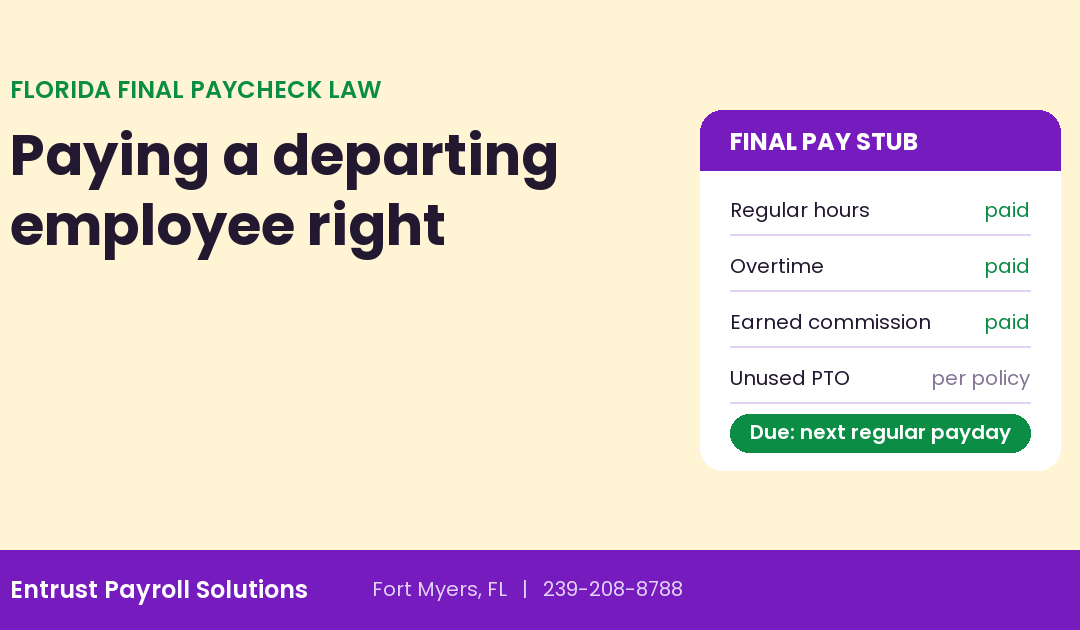
TL;DR: There is no Florida final paycheck law setting a deadline, and federal law does not require immediate payment either. The safe rule is to pay the final check on the next regular payday, for every hour worked, including overtime. Florida does not require unused PTO to be paid out, so your written policy decides. Deductions for unreturned equipment cannot drop pay below minimum wage.
When an employee leaves, especially on bad terms, the final paycheck is where a clean separation turns into a dispute. The first question is almost always some version of “how long do I have?” In Florida the answer is more relaxed than in most states, but “no state law” is not the same as “no rules.” Here is what the Florida last paycheck rules actually require, and the mistakes that turn a routine termination into a wage claim. If terminations are the part of HR you most want off your plate, our HR services cover separations from the final check to the paperwork.
When is a final paycheck due in Florida?
Florida has no statute setting a deadline for a final paycheck, and federal law does not require one to be paid immediately. In practice, employers should pay the final wages no later than the next regularly scheduled payday for the period worked. That is the point at which the employee can go to the Department of Labor.
The U.S. Department of Labor’s page on the last paycheck states that “employers are not required by federal law to give former employees their final paycheck immediately.” The same page tells employees who have not been paid by the regular payday for their last pay period to contact the Wage and Hour Division or their state labor department.
So the regular payday is the line that matters. Missing it is where a former employee’s complaint becomes a federal wage issue. Paying on the regular cycle also has a practical advantage for you: the final check runs through your normal payroll, with normal withholding and normal tax deposits, and nothing has to be calculated by hand.
What has to be in the final paycheck?
The final paycheck must include all wages earned through the last day worked: regular hours, overtime at time and a half, and any commissions or non discretionary bonuses already earned under your pay plan. Federal minimum wage and overtime rules apply to the final week exactly as they do to every other week.
A few items get missed often enough to list:
- Overtime in a partial week. Overtime hours in the final week are owed at time and a half, even if the employee quit on a Thursday. See our guide to Florida overtime laws.
- The new minimum wage. Any hours worked on or after September 30, 2026 must be paid at least $15.00 an hour. Our Florida minimum wage 2026 guide has the details.
- Earned commissions. If your commission plan says a commission is earned when the sale closes, a sale that closed before the last day is owed.
- Normal withholding. Taxes are withheld and deposited just like any other payroll. The employee’s W-2 is still due by January 31. Confirm their mailing address before they leave.
Getting the final pay stub right matters as much as the amount. Our post on getting it right on the pay stub covers what should appear on it.
Does Florida require PTO payout at termination?
No. Florida does not require employers to pay out unused vacation or PTO when an employee leaves, and neither does federal law. Whether unused PTO is paid out depends on your written policy, offer letter or employment contract. If your policy promises a payout, you have to honor it.
The Department of Labor’s page on vacation leave explains that the Fair Labor Standards Act “does not require payment for time not worked, such as vacations,” and that these benefits “are matters of agreement between an employer and an employee.”
That puts the weight on your handbook. The most common problem is not a bad policy but no policy at all, or one that says something different from what the business actually does. If you have paid out PTO to some departing employees and not others, expect the next person who is denied to point to the ones who got it. Decide the rule, write it down, and apply it the same way every time. Two older posts go deeper on this: PTO restrictions and what you need to know and creating good vacation policies.
| Situation | Must you pay out unused PTO in Florida? |
|---|---|
| No written policy on payout | Not required by Florida or federal law, but an unclear policy invites disputes |
| Policy says unused PTO is paid out | Yes, pay it as the policy says |
| Policy says unused PTO is forfeited | Generally no, if the policy was communicated in advance |
| Policy pays out only with two weeks’ notice | Follow the policy as written, consistently |
Can an employer hold a final paycheck in Florida?
An employer should not hold a final paycheck past the next regular payday, and cannot withhold it as leverage to get equipment, keys or a uniform returned. Deductions for unreturned property are risky and can never reduce the employee’s pay below the minimum wage or cut into overtime owed.
That limit comes from the federal “free and clear” rule, 29 CFR 531.35. Wages have to be paid free and clear, and a cost the employer passes back to the employee, such as tools, equipment or a uniform, is a violation in any week it cuts into the minimum wage or overtime owed. On a final check for a minimum wage employee, there is essentially no room for a deduction at all.
The safer approach is to get a signed, written authorization for any deduction at hiring, collect equipment on the last day before the employee leaves the building, and treat anything still outstanding as a separate matter. Holding the whole check turns a $200 laptop charger into a wage claim.
Is the final paycheck different if you fire someone?
No. Florida applies the same rules whether an employee quits, is laid off or is fired. There is no state deadline in any of those cases, and the final paycheck should be paid on the next regular payday either way. What differs is the paperwork around it, not the timing.
A termination still carries risks beyond the check itself. Document the reason for the separation, because it matters if the former employee files for Reemployment Assistance, and every charged claim can raise your Florida reemployment tax rate. And treat the final paycheck the same way for everyone, so it never looks like punishment. Our post on how to avoid workplace retaliation claims explains why consistency is your best protection.
Frequently asked questions about Florida final paycheck law
How long does an employer have to pay you after termination in Florida?
Florida has no specific deadline. The final paycheck should be paid no later than the next regular payday. After that date, the employee can contact the U.S. Department of Labor’s Wage and Hour Division.
Does Florida require PTO payout when you quit?
No. Florida law does not require payout of unused PTO when an employee quits or is fired. The employer’s written policy or contract decides whether PTO is paid out.
Can my employer deduct unreturned equipment from my final paycheck in Florida?
Only within limits. A deduction for equipment or uniforms cannot bring the employee’s pay below the federal minimum wage or reduce overtime owed, and a signed written authorization is strongly advisable.
Is there a Florida last paycheck law?
No. Florida has no statute governing the timing of a final paycheck. Federal wage rules and the employer’s own policies govern what must be paid and when.
Make every separation clean
A departing employee is the one time a payroll mistake is almost guaranteed to be noticed. We handle final paychecks, PTO payout calculations and separation paperwork for businesses across Southwest Florida, from our office in Fort Myers. Get a free quote or contact me at 239-208-8788.