
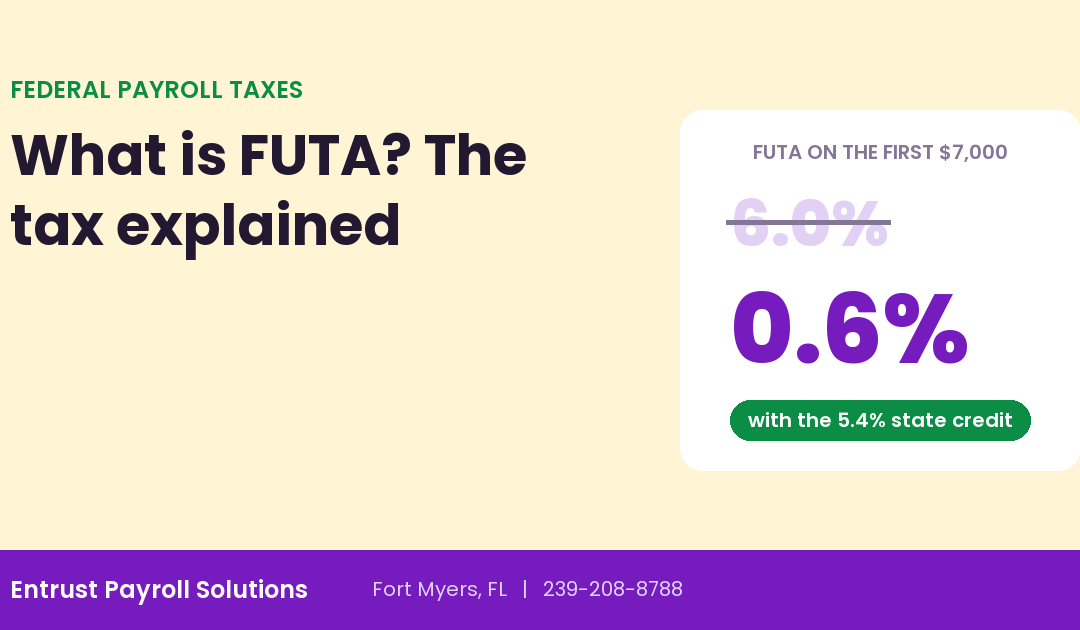
TL;DR: What is FUTA? It is the federal unemployment tax, paid only by employers, at 6.0% on the first $7,000 each employee earns in a year. Employers who pay their state unemployment tax in full and on time get a credit of up to 5.4%, which cuts the real rate to 0.6%, or $42 per employee. It is reported once a year on Form 940.
FUTA is the payroll tax most small business owners have never heard of until the first Form 940 lands on their desk. It is small per employee, but it has its own filing, its own deposit rules and a credit that depends entirely on paying a different tax on time. Here is what FUTA is, what it costs, and how it connects to the Florida reemployment tax you already pay every quarter.
What is FUTA and how does it work?
FUTA stands for the Federal Unemployment Tax Act. Together with each state’s unemployment program, it funds unemployment benefits for workers who lose their jobs. Employers pay FUTA to the IRS on the first $7,000 of each employee’s wages per year, then report it annually on Form 940.
The federal share pays for administering unemployment programs and for loans to states whose unemployment funds run short. The benefits themselves come mostly from state unemployment taxes, which in Florida is the reemployment tax. That split is why the two taxes are linked: pay the state tax properly, and the federal tax drops by 90%.
Who pays FUTA tax?
Only the employer pays FUTA tax; it is never withheld from an employee’s paycheck. You owe FUTA if you paid $1,500 or more in wages in any calendar quarter, or had at least one employee for part of a day in 20 or more different weeks, in the current or prior year.
The IRS confirms both points: its federal unemployment tax guidance states plainly that the employer alone pays it, and the $1,500 and 20-week tests are set out in its Topic 759 on Form 940 and FUTA. Almost every business with a regular employee meets them. Separate tests apply to household employers, such as families paying a nanny, and to farms. If you employ someone in your home, our household employee payroll service handles those rules.
Independent contractors do not count toward FUTA. That is one more reason worker classification matters; our guide to 1099 vs. W2 classification in Florida explains the test.
What is the FUTA tax rate?
The FUTA tax rate is 6.0% on the first $7,000 of wages paid to each employee in a calendar year, a maximum of $420 per employee. Employers that pay state unemployment tax in full and on time receive a credit of up to 5.4%, so the effective FUTA rate is 0.6%, or $42 per employee per year.
Here is what that means for a small Florida business, assuming each employee earns at least $7,000 in the year:
| Employees | FUTA at 0.6% (full credit) | FUTA at 6.0% (no credit) |
|---|---|---|
| 1 | $42 | $420 |
| 5 | $210 | $2,100 |
| 10 | $420 | $4,200 |
| 25 | $1,050 | $10,500 |
The gap between those columns is the whole story of FUTA. Lose the credit and the tax is ten times higher, and you keep it only by paying your Florida reemployment tax completely and by the deadline. Our post on quarterly payroll tax deadlines in Florida lists those dates.
Like the Florida reemployment tax, FUTA stops once an employee’s wages for the year pass $7,000. For most full-time staff, that happens early in the year, so the tax is concentrated in the first quarter.
FUTA vs. SUTA: how the two taxes fit together
FUTA is the federal unemployment tax, paid to the IRS once a year on Form 940. SUTA is the state unemployment tax, which Florida calls reemployment tax and collects quarterly on Form RT-6. Both are employer-only taxes on the first $7,000 of wages, and paying SUTA on time is what earns the FUTA credit.
In Florida the two taxes happen to share the same $7,000 wage base. Other states often have a much higher state wage base, which is one of the few ways Florida’s payroll tax picture is simpler than most. Our Florida reemployment tax guide covers the state side: the 2.7% new employer rate, how your rate moves with claims, and who has to register.
What is a FUTA credit reduction state?
A credit reduction state is one that borrowed from the federal government to pay unemployment benefits and has not repaid the loan. Employers in those states lose part of the 5.4% credit, so they pay more than 0.6%. The Department of Labor determines the list each year, and the extra amount is reported on Schedule A of Form 940.
Before you file each year, check whether Florida or any other state where you have employees is on that year’s list. The IRS instructions for Form 940 direct employers to Schedule A for the details. If you have employees in more than one state, the credit is figured state by state.
How do you file Form 940?
Form 940 is the annual federal return that reports FUTA tax. It is normally due January 31 for the prior year; when that date falls on a weekend, it moves to the next business day. Employers who deposited all their FUTA tax on time get an extra ten days to file.
The IRS instructions for Form 940 show how that worked for 2025 wages: the return was due February 2, 2026, because January 31 fell on a Saturday, or February 10, 2026 for employers whose deposits were all made on time.
You may also have to deposit FUTA during the year, before the return is due. The rule works on a running total:
- Calculate your FUTA liability each quarter.
- If it is $500 or less, carry it forward to the next quarter.
- Once the cumulative amount passes $500, deposit it by the last day of the month after that quarter ends.
- Whatever is left for the fourth quarter is paid with Form 940 or deposited, depending on the amount.
For a business with a handful of employees at the 0.6% rate, the total for the year is often under $500, so a single payment with the return is common. Larger teams will usually make a first-quarter deposit by April 30.
Common FUTA mistakes to avoid
- Paying the state tax late. A late RT-6 payment can cost you part of the FUTA credit, turning a $42 bill into a much larger one.
- Counting contractors or leaving out part-time staff. FUTA applies to all employees, part-time and temporary included, but not to genuine contractors.
- Missing the first deposit. Growing businesses cross the $500 threshold without noticing.
- Assuming the due date is always January 31. Weekends shift it, as they did for 2025 returns.
January is the heaviest month on the payroll calendar: Form 940, the fourth-quarter 941 and RT-6, and every employee’s W-2 all land at once. Our quarter-end and year-end payroll service exists for exactly that month.
Frequently asked questions about FUTA
Is FUTA deducted from employee paychecks?
No. FUTA is paid only by the employer. It is never withheld from an employee’s wages and does not appear as a deduction on the pay stub.
What is the FUTA wage base?
The FUTA wage base is $7,000 per employee per calendar year. Wages above $7,000 paid to the same employee in the same year are not subject to FUTA tax.
When is Form 940 due?
Form 940 is due January 31 for the prior calendar year, or the next business day if January 31 falls on a weekend. Employers who made all FUTA deposits on time have ten extra days to file.
Do I pay FUTA if I pay Florida reemployment tax?
Yes. Florida reemployment tax and FUTA are separate taxes, and you owe both. Paying the Florida tax in full and on time earns a credit of up to 5.4% against FUTA, reducing it to 0.6%.
Let us handle FUTA and Form 940
FUTA is a small tax with an outsized penalty for getting the state side wrong. We file Form 940, track the $500 deposit threshold and keep your Florida reemployment tax on time so the credit is never at risk. As a local payroll tax service in Fort Myers, we work with businesses across Southwest Florida. Get a free quote or contact me at 239-208-8788.