
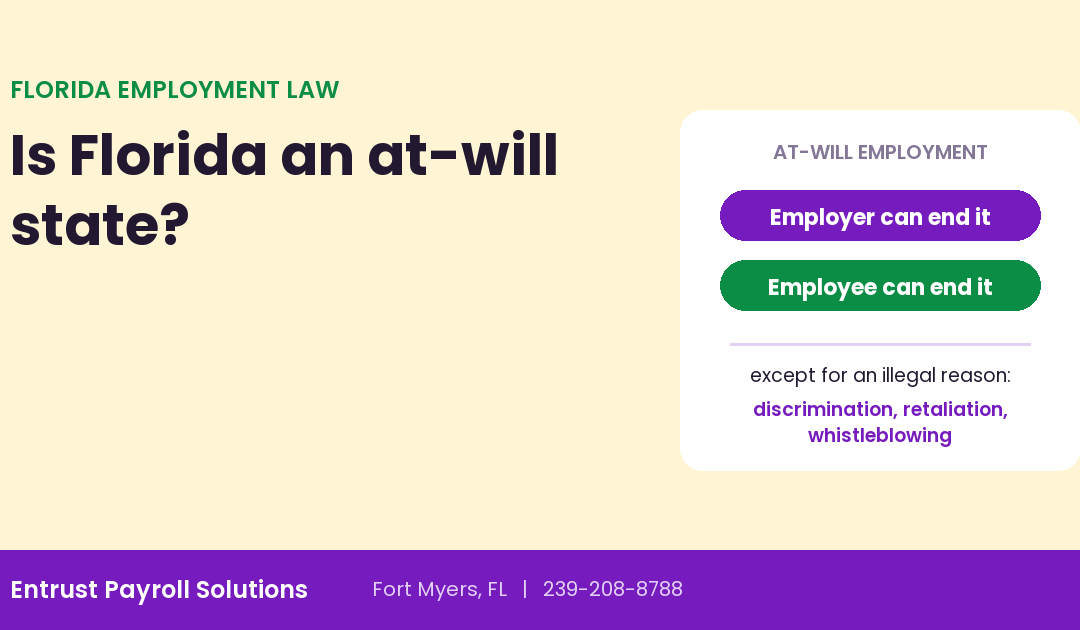
TL;DR: Is Florida an at-will state? Yes. Florida is an at-will employment state: without a contract or union agreement, an employer can end employment at any time for any lawful reason or no reason, and the employee can quit the same way. But at-will has limits. Firing someone for a protected reason, like discrimination, whistleblowing or a workers’ comp claim, is still illegal.
Owners often hear “Florida is a fire at will state” and take it to mean they can let anyone go, any time, with no risk. That is half right. At-will gives Florida employers a lot of freedom, but most wrongful termination claims are not about the at-will rule at all. They are about the exceptions. Here is how both work, and what to put in place so a termination stays clean. For the pay side of a separation, see our guide to Florida final paycheck law.
What does at-will employment mean in Florida?
At-will employment in Florida means either the employer or the employee can end the working relationship at any time, with or without a reason and without notice, unless an employment contract, union agreement or government employment rule says otherwise. No warning, progressive discipline or appeal is required by law.
Jacksonville Area Legal Aid’s guide to Florida at-will employment puts it the same way: in Florida, employment is at will, and either side can end it at any time without reason unless a contract or union agreement governs the job. It also notes that written warnings and progressive discipline are usually voluntary policies, not legal requirements.
That last point cuts both ways. You do not have to give warnings. But if your handbook promises a progressive discipline process, courts and agencies will look at whether you followed it, and whether you applied it the same way to everyone.
What can’t you fire someone for in Florida?
Even in an at-will state, a Florida employer cannot fire someone for an illegal reason. The main ones are discrimination based on a protected characteristic, retaliation for whistleblowing, retaliation for filing a workers’ compensation claim, and punishing an employee for jury service. A lawful reason, or no reason, is fine; an unlawful reason is not.
The most common exceptions Florida employers run into:
- Discrimination. The Florida Civil Rights Act makes it unlawful to fire someone because of race, color, religion, sex, pregnancy, national origin, age, handicap or marital status. It applies to employers with 15 or more employees; federal laws cover similar ground with their own thresholds.
- Whistleblowing. Florida’s private sector whistleblower law protects employees who report or object to an employer’s violation of a law, rule or regulation.
- Workers’ compensation claims. Florida law bars firing or threatening an employee because they filed, or tried to file, a valid workers’ comp claim.
- Jury duty and military service. Both are protected under state and federal law.
- Contracts. An offer letter or agreement that promises employment for a set term, or termination only “for cause,” changes the rules for that employee.
Is Florida a right-to-work state? (A different thing)
Yes, Florida is a right-to-work state, but that is a separate rule from at-will employment. Right to work means no one can be required to join, or pay, a labor union as a condition of employment. It says nothing about when an employer can fire someone. People confuse the two constantly.
Florida law gives employees the right to form, join or assist a union, or to refrain from doing so. The legal aid guide above makes the distinction directly: “right to work” only means a person cannot be denied employment based on union membership, and it does not create any job security. At-will is the rule about ending employment; right to work is the rule about unions.
Whistleblower protection: the exception employers miss
Florida’s private whistleblower law is the at-will exception that surprises employers most, because it can apply to an ordinary internal complaint. Under Florida Statute 448.102, an employer may not take retaliatory action against an employee who objects to, or refuses to take part in, an activity, policy or practice that violates a law, rule or regulation.
The same statute protects employees who disclose a violation to a government agency, after first raising it with the employer in writing, and those who provide information to an investigation. The practical takeaway: if an employee has recently complained that something is illegal, whether it is about overtime, safety or anything else, be very careful about the timing and documentation of any termination that follows. Our post on how to avoid workplace retaliation claims goes deeper on this.
How to protect your business in an at-will state
At-will is a legal default, not a strategy. The businesses that avoid claims usually do a few simple things:
- Say it in writing. State in your offer letters and handbook that employment is at will, and avoid promises like “permanent position” or “you will only be let go for cause.”
- Document performance as it happens. Not every termination needs a reason, but if one is challenged, contemporaneous notes carry far more weight than a reason reconstructed later.
- Be consistent. Apply the same standards and discipline to everyone. Inconsistency is what turns a lawful termination into a discrimination claim.
- Watch the timing. A termination soon after a complaint, a workers’ comp claim or a request for leave invites scrutiny.
- Handle the exit cleanly. Pay the final check on time and document the reason for separation, since it matters if the former employee files for Reemployment Assistance and can affect your Florida reemployment tax rate.
Our HR services include handbook language and termination checklists built around exactly these steps.
Frequently asked questions about at-will employment in Florida
Can you be fired without warning in Florida?
Yes. Florida is an at-will state, so an employer can end employment without warning or a stated reason, unless a contract, union agreement or the employer’s own written policy promises otherwise. The firing cannot be for an illegal reason.
Do employees have to give two weeks’ notice in Florida?
No. Florida law does not require employees to give notice before quitting. At-will works both ways. An employer can ask for notice in its policies, and an employment contract can require it.
Does an employer have to say why an employee was fired in Florida?
No Florida law requires an employer to give a reason for termination. Documenting the real reason internally is still wise, because it matters if the decision is challenged or the former employee files for Reemployment Assistance.
Is Florida a fire at will state?
Yes. Florida follows at-will employment, often described as “fire at will.” Employers may end employment for any lawful reason or no reason, but not for a discriminatory or retaliatory one.
Talk to someone before a difficult termination
At-will makes most terminations simple, and a few of them very risky. If you are unsure about a separation, get advice before the conversation, not after. We support businesses across Fort Myers, Cape Coral and Naples with HR and payroll. Get a free quote or contact me at 239-208-8788.