
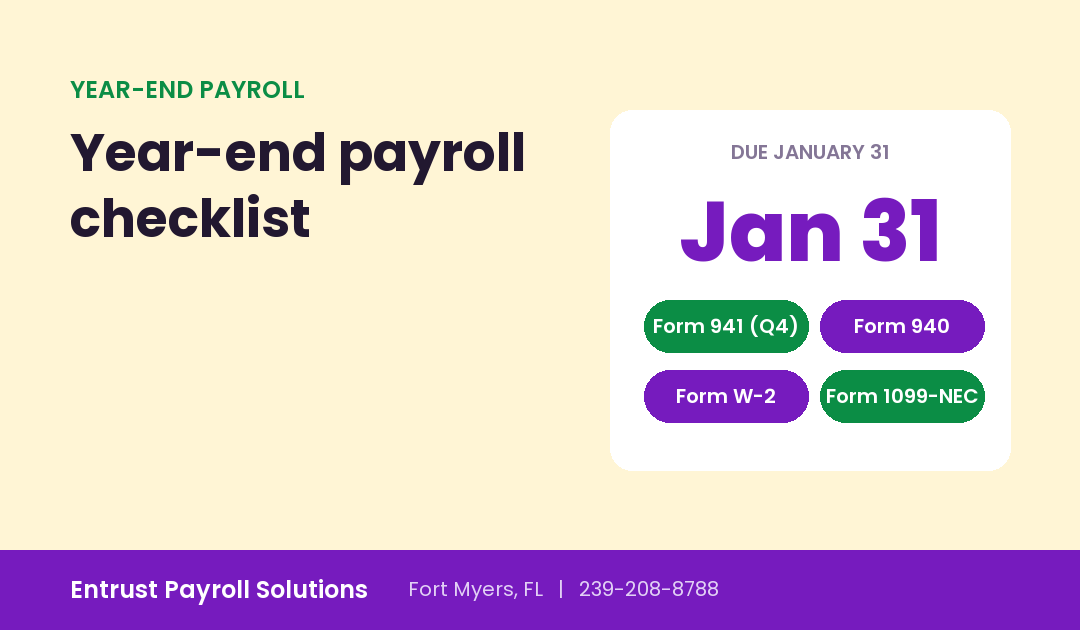
This year-end payroll checklist covers what Florida employers should do before January 31: verify employee records, reconcile payroll totals to your tax filings, run the year-end reports, and prepare the fourth-quarter Form 941, Form 940, W-2s and 1099-NECs. The IRS lists all of those as due January 31. Start in November, when a mistake is a quick fix instead of a corrected filing. It’s also the right time to look ahead to your own tax season.
The work isn’t hard, but it bunches into one month. If you’d rather hand it off, our quarterly and year-end payroll service covers all of it. If you’re doing it yourself, work down this list in order, and keep our guide to quarterly payroll tax deadlines in Florida open next to it.
What Should a Year-End Payroll Checklist Include?
A year-end payroll checklist should include five things, in this order:
- Verify records. Names, addresses and Social Security numbers for every employee, plus taxpayer details for every contractor you paid.
- Reconcile. Make your payroll totals agree with your quarterly filings and tax deposits.
- Run the reports. Pull the full-year reports before the first January payroll changes anything.
- Confirm the due dates. Put the January deadlines on the calendar, with a buffer.
- Plan the new year. Pay rates, deductions, withholding and any change in how you pay people.
Step 1: Verify Your Employee and Contractor Records
Start with the boring part, because it’s where most W-2 problems begin. The IRS says employers must get each employee’s name and Social Security number and enter them on Form W-2, and that an ITIN can’t be used in place of a Social Security number for employment. See the IRS page on hiring employees.
Send each employee a one-page summary of what you have on file: legal name as it appears on the Social Security card, mailing address, and the address where you want the W-2 delivered. People move, marry and change their names. A wrong name on a W-2 means a correction later, and our post on how to avoid incorrect W-2 forms walks through the usual causes.
Do the same for contractors. Confirm you have their legal name, address and taxpayer information before January, not while you’re trying to file. And confirm they’re really contractors: our guide to 1099 vs. W-2 classification in Florida explains the test, and year-end is a good moment to re-check any worker you’re unsure about.
How Do You Reconcile Payroll Totals Before the Year Ends?
Compare the year-to-date wages, withholding and tax deposits in your payroll register against your four quarterly Form 941 filings and your deposit records. The totals should match to the dollar. A gap found in November can be fixed in a normal payroll. A gap found after W-2s go out means corrected forms.
- Total the gross wages for the year from your payroll register.
- Total the wages reported on your four quarterly Form 941 returns.
- Compare federal tax withheld in the register to the withholding on the returns and to what you actually deposited.
- Investigate any difference, even a small one. Small gaps usually come from a late-year correction, a voided check or a bonus run outside the normal payroll.
If you also pay Florida reemployment tax, run the same comparison against your quarterly state returns. Our Florida reemployment tax guide covers what that return reports.
Which Year-End Payroll Reports Should You Run?
Run these five reports. Together they show wages, taxes withheld, taxes deposited and benefit deductions, which are the figures your January forms must agree with.
- Payroll register for the year: every payment to every employee, and the master record the others are checked against.
- Tax liability report: what you owed in payroll taxes and when, compared to what you deposited.
- Quarterly summaries: one per quarter, to match to each Form 941.
- Employee earnings summary: each person’s year-to-date pay, where the W-2 numbers come from.
- Deductions report: health premiums, retirement contributions and garnishments, so the W-2 reflects them correctly.
Save these as PDFs before January. Once the new year’s payrolls start, it’s easy to lose track of which figures belong to which year, so keep a clean copy you never touch.
When Are Year-End Payroll Forms Due?
The IRS lists the fourth-quarter Form 941, Form 940, Form W-2 for employees and Form 1099-NEC as all due January 31. If a return falls on a weekend or legal holiday, the IRS allows filing on the next business day. Employers who deposited all their taxes on time get ten extra days for Forms 941 and 940. These dates come from the IRS list of employment tax due dates.
| Form | Who gets it | Due |
| Form 941 (fourth quarter) | IRS | January 31 |
| Form 940 (annual federal unemployment tax) | IRS | January 31 |
| Form W-2 | Employees | January 31 |
| Forms W-2 and W-3 | Social Security Administration | See the IRS page and the SSA website |
| Form 1099-NEC | IRS and contractors | January 31 |
January 31, 2027 falls on a Sunday, so the next business day is Monday, February 1. I wouldn’t plan around that. Treat Friday, January 29 as your real deadline and you’ll never be caught out by a late-night upload or a rejected file.
The Florida side lands in the same weeks. Your fourth-quarter reemployment tax return is a separate state filing, covered in our quarterly deadlines guide. The federal credit on Form 940 depends on paying the state tax correctly, so the two are connected. See what FUTA is.
What Should You Change Before the New Year Starts?
The new year is the cleanest time to make payroll changes, because nobody has to explain a mid-year shift. Update pay rates, deductions and pay schedule so they start with the first payroll of the year, and tell employees before they see it on a pay stub.
- Pay rates against the minimum wage: Florida’s minimum wage reached $15.00 on September 30, 2026. Our post on the Florida minimum wage explains who this affects. Confirm no one is below it, including tipped staff.
- Year-end bonuses and final checks: anything dated December 31 or earlier goes on this year’s W-2, and anything dated January 1 or later goes on next year’s. See the tax implications of bonuses.
- Withholding: anyone who has married, divorced or had a child may want to update their W-4. Employees can submit a new one at any time.
- Annual limits and thresholds: retirement plan, IRA and HSA contribution limits, the standard deduction and ACA affordability figures all get adjusted every year. Confirm the new-year numbers with the IRS or your tax adviser before updating payroll deductions and benefit plans.
- Your pay schedule: if you’ve been thinking about switching, the new year is the time. Our comparison of semi-monthly vs. biweekly payroll lays out the trade-offs.
How Do You Get Ready for Your Own Tax Season?
Payroll filings aren’t the only deadline. Whether you’re an employee, self-employed or a business owner, the individual or business return is still coming in the spring. The IRS and tax professionals urge early filing, and the best preparation is to review the past year while the details are fresh.
- Gather documents gradually: W-2s, 1099s, mortgage and investment statements, and last year’s return. The list of what the IRS needs stays pretty much the same each year, even when the laws change.
- Check your driving logs: if you drive for business, the IRS publishes optional standard mileage rates, and dated logs are what support the deduction.
- Review your withholding or estimated payments: if your income or family situation changed this year, adjust now rather than at filing time.
- Confirm your filing deadline: the individual deadline is in April, but weekends and holidays can shift the exact date, so check the IRS before you plan around it.
- Work with your tax adviser: tax law is never simple, and a short conversation in December beats a scramble in April.
Year-End Payroll for Businesses in Fort Myers, Cape Coral and Naples
Southwest Florida businesses have a wrinkle most of the country doesn’t: seasonal staffing. If you bring people on for the winter season and let them go in spring, you may have employees who worked a few months and still need a W-2. Make sure their last known address is current before they leave town, and confirm where to send the form.
Restaurants and hospitality businesses have the most to check, because tipped wages, turnover and short stints all land on the same W-2 run. If that’s you, see our guide to restaurant payroll in Fort Myers.
Year-End Payroll FAQs
What are the key items to include in a year-end payroll checklist?
Verified employee and contractor records, a reconciliation of payroll totals to your tax filings, the full-year payroll reports, the January 31 forms and due dates, and planned changes for the new year such as pay rates and deductions.
What forms are due January 31 for employers?
The IRS lists the fourth-quarter Form 941, Form 940, Form W-2 for employees and Form 1099-NEC for contractors as due January 31. If the date falls on a weekend or legal holiday, the next business day applies.
Do independent contractors get a W-2?
No. Independent contractors receive Form 1099-NEC, and only employees receive a W-2. If you’re unsure which someone is, resolve that before you file, because the wrong form is a classification problem, not a paperwork one.
When should I start year-end payroll?
Start in November. That leaves time to verify records, reconcile totals and fix anything you find, all before the first January payroll and well before the January 31 deadline.
Do retirement and HSA contribution limits change every year?
Yes. The IRS adjusts them annually, so confirm the new numbers before you update payroll deductions or benefit plans, and ask your tax adviser how they affect you personally.
Should I wait until April to deal with my own taxes?
It’s better not to. Gather documents and review your withholding now, and file early where you can. Early preparation makes it easier to catch problems and avoid a last-minute rush.
Let Me Handle Your Year-End Payroll
Year-end is the month payroll mistakes get expensive, and it’s the month a local payroll partner earns its keep. When you call, you get me, not a ticket. If you want the January forms handled correctly, get a free quote or contact me at 239-208-8788. I work with businesses in Fort Myers, Cape Coral, Naples, Estero, Bonita Springs and Lehigh Acres, and our payroll tax service takes the deposits and filings off your plate all year.