
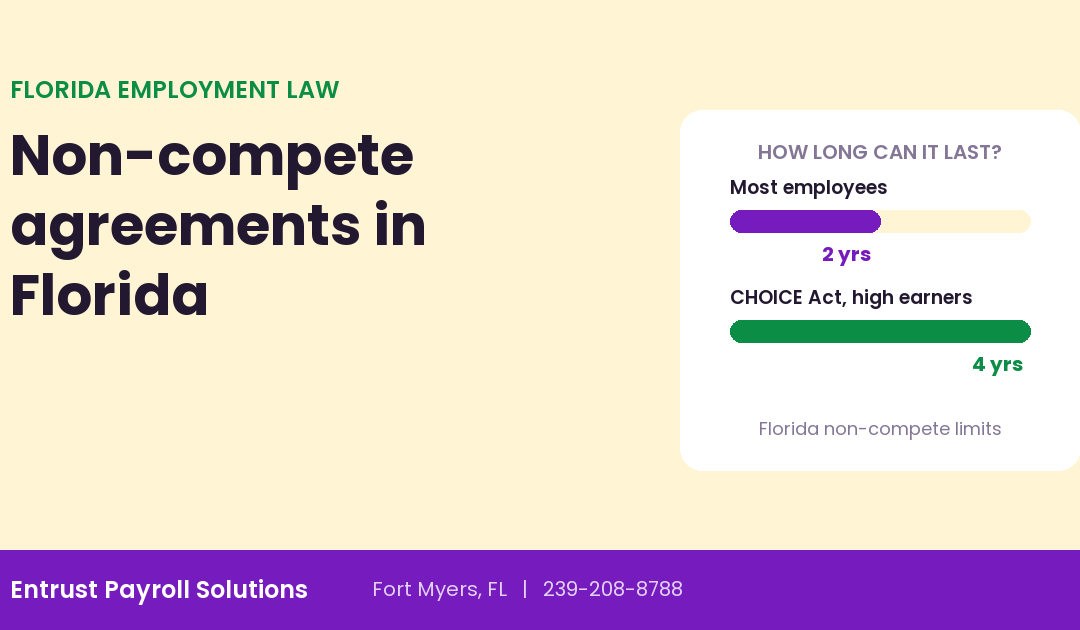
A non-compete agreement in Florida is enforceable if it is in writing, signed by the employee, protects a legitimate business interest and is reasonable in time, area and scope. For most employees, courts presume six months or less reasonable and more than two years unreasonable. Since July 1, 2025, the CHOICE Act allows up to four years for high earners who meet its strict requirements.
Florida has long been one of the most employer-friendly states for non-competes, and in 2025 it became even more so. But “enforceable” does not mean automatic. A non compete Florida employers can actually rely on has to meet specific statutory requirements, and a poorly drafted one can fail exactly when you need it. Here is how Florida’s non-compete law works, what the CHOICE Act changed, and how to decide whether you need one at all. Because non-competes only matter when someone leaves, read this alongside our guide to whether Florida is an at-will state.
Is a non-compete enforceable in Florida?
Yes. Non-compete agreements are enforceable in Florida when they meet the requirements of Florida Statute 542.335: a written agreement signed by the employee, at least one legitimate business interest to protect, and restrictions that are reasonable in duration, geographic area and line of business. An agreement that fails any of these can be challenged.
Florida is unusual here. Some states ban most employee non-competes outright. Florida’s statute instead tells courts to enforce restrictive covenants that meet its conditions, which is why careful drafting matters more than whether you have one.
This is general information, not legal advice. Have an employment attorney draft or review any non-compete you plan to enforce.
What does Florida non-compete law require?
Florida non-compete law, found in Florida Statute 542.335, requires three things. The agreement must be in writing and signed by the person it will be enforced against. The employer must prove a legitimate business interest, such as trade secrets, confidential business information or substantial customer relationships. And the restriction must be reasonably necessary to protect that interest.
The statute’s own text, available at Florida Statute 542.335, sets the time presumptions for employees: a restriction of 6 months or less is presumed reasonable, and one lasting more than 2 years is presumed unreasonable. Anything in between has to be justified by the facts.
“Legitimate business interest” is the part employers most often underestimate. A non-compete that exists only to keep a worker from taking a job with a competitor, without any trade secrets, confidential information or customer relationships at stake, is hard to enforce. The same statute covers related restrictive covenants such as non-solicitation and confidentiality agreements, which are often a better fit for rank-and-file staff.
What is the Florida CHOICE Act?
The Florida CHOICE Act is a 2025 law that makes non-compete and garden leave agreements much easier to enforce for higher-earning employees. It took effect July 1, 2025, and applies to employees and contractors earning more than twice the annual mean wage of the relevant Florida county. It allows non-competes of up to four years and shifts the burden of proof to the employee.
DLA Piper’s summary of the CHOICE Act taking effect sets out the key terms:
- Garden leave: up to four years’ notice; work can be required in the first 90 days only.
- Who is covered: employees and contractors whose base salary is more than twice the annual mean wage of the county where the employer’s principal place of business is, or where the employee lives if the employer is out of state. Healthcare professionals are excluded.
- Length: covered non-competes can last up to four years.
- Burden of proof: it moves to the employee, who must show the agreement is unenforceable.
- Process requirements: the employer must give the agreement at least seven days before the offer expires, advise the employee in writing of the right to consult a lawyer, and get a written acknowledgment that the employee will receive confidential information or customer relationships.
The CHOICE Act does not replace Florida Statute 542.335. It adds a second, stronger option for covered agreements signed on or after July 1, 2025. For most small business employees, who earn well below twice their county’s mean wage, the older statute and its two-year presumption still apply.
Garden leave: the other half of the CHOICE Act
The CHOICE Act also recognizes garden leave agreements. Under a covered garden leave agreement, an employee must give advance notice before leaving, up to four years, and stays on the payroll at base salary and benefits during that notice period. After the initial working period described above, the employee is not required to work.
Garden leave is a payroll commitment as much as a legal one: you keep paying salary and benefits for someone who may not be working. For a small business, that is only worth it for a genuinely critical role. If you do use it, make sure your payroll setup can carry a non-working employee on salary cleanly, including benefits deductions and tax withholding.
How to write a non-compete that holds up
A non compete clause in Florida is only as strong as its drafting. The basics that make enforcement easier:
- Put it in writing and get it signed, ideally at the start of employment.
- Name the legitimate business interest. Say what you are protecting: specific customer relationships, confidential pricing, trade secrets.
- Keep the time reasonable. For employees outside the CHOICE Act, staying within two years avoids the presumption of unreasonableness; shorter is easier to defend.
- Limit the area and scope. A restriction covering Lee and Collier counties is easier to justify for a Fort Myers business than one covering the whole state.
- Consider a lighter tool. A non-solicitation or confidentiality agreement may protect what you actually care about with less risk.
- Follow the CHOICE Act steps exactly if you want its benefits for a high earner: seven days to review, written notice of the right to counsel, and the written acknowledgment.
Keep signed agreements with the employee’s personnel file. Our HR services help small businesses organize onboarding paperwork, and our new hire paperwork checklist shows where agreements like this fit.
Do you actually need a non-compete?
Many small businesses do not. For hourly staff and most entry-level roles, a non-compete is expensive to enforce and often unenforceable, because there is no legitimate business interest beyond not wanting to lose a good worker. Retention is usually the better investment: fair pay, clear policies and a workplace people want to stay in. Our posts on ways small businesses can attract employees and employee turnover cover that side.
Non-competes make the most sense for roles with real access to customer relationships, pricing, or proprietary methods: senior salespeople, account managers, key technicians. Those are also the roles most likely to fall under the CHOICE Act if pay is high enough.
Frequently asked questions about non-competes in Florida
How long are non-competes good for in Florida?
For most employees, Florida courts presume a non-compete of six months or less is reasonable and one longer than two years is unreasonable. Under the 2025 CHOICE Act, covered high earners can be bound for up to four years.
Can you get out of a non-compete in Florida?
Sometimes. An employee can challenge a non-compete that lacks a signed writing, a legitimate business interest, or reasonable limits. Under the CHOICE Act, the burden shifts to the employee to prove the agreement unenforceable.
Is a 2-year non-compete legal in Florida?
Yes, generally. For employees, two years sits at the edge of Florida’s presumption: restrictions longer than two years are presumed unreasonable. A two-year term still has to protect a legitimate business interest.
What changed in Florida’s non-compete law in 2025?
The CHOICE Act took effect July 1, 2025. For employees earning more than twice their county’s annual mean wage, it allows non-competes and garden leave of up to four years and makes them easier to enforce.
Get your paperwork right from day one
Non-competes, offer letters and handbooks work best when they are set up at hiring, not after someone resigns. We help businesses in Fort Myers, Naples and across Southwest Florida with HR and payroll. Get a free quote or contact me at 239-208-8788.