
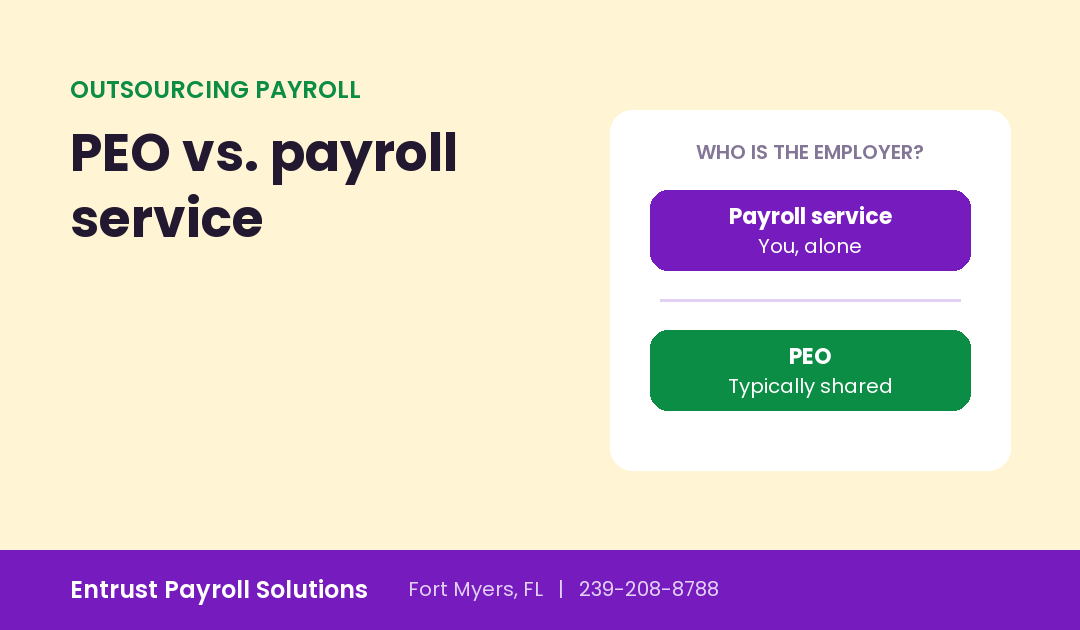
PEO vs payroll service comes down to control. A payroll service runs your payroll and payroll taxes while you stay the only employer and keep your own benefits, policies and HR. A PEO usually shares employer responsibilities with you and bundles payroll, benefits and HR support into one contract. Most small Florida businesses need the first. Some growing ones need the second.
I run a payroll and HR services company, not a PEO, so weigh my opinion with that in mind. What follows is as even-handed as I can make it, including the downsides of the option I do not sell. If you are still deciding whether to outsource at all, start with our guide on when to outsource payroll, then come back here.
What is a PEO in payroll?
A PEO, or professional employer organization, is a company that takes over payroll administration and often benefits and HR support for its business clients. The IRS says PEOs handle various payroll administration and tax reporting responsibilities for their clients, and are typically paid a fee based on payroll costs.
That description comes from the IRS page on certified professional employer organizations. The part the IRS does not spell out, and the part that matters most when you compare options, is the structure. In a typical PEO arrangement you and the PEO share employer responsibilities for your staff, which is often called co-employment. That is why PEOs can offer group benefits and handle HR matters, and also why they ask you to give up some control.
What is the difference between a PEO and a payroll service?
A payroll service processes pay, withholds and deposits taxes, and files returns, while you remain the sole employer and decide everything else. A PEO typically adds co-employment, group benefits and HR support under one contract. The difference is how much responsibility, and how much control, moves to the provider.
Here is the PEO vs payroll services comparison side by side:
| Payroll service | PEO | |
|---|---|---|
| Runs payroll and payroll taxes | Yes | Yes |
| Who is the employer | You, alone | Shared with the PEO (co-employment) |
| Benefits | You choose and buy your own | Typically offered through the PEO’s plans |
| HR support | Separate, if offered | Typically bundled |
| Your control over policies and vendors | Full | Reduced |
| How you are billed | Fee for payroll services | Fee typically based on payroll costs |
| Leaving | Switch providers | Often tied to benefits and contract terms, so ask |
The table describes the typical shape of each arrangement. Contracts vary, so treat it as a list of questions to ask, not a promise about any one company.
What are the downsides of using a PEO?
The main downsides are less control, a bundled contract that is harder to leave, and paying for services you may not use. Because a PEO usually shares the employer role, your benefits and policies are shaped by its offering. Read the contract length and exit terms before you sign anything.
A few specifics to press on:
- Benefits lock-in. If your health plan comes through the PEO, leaving the PEO can mean changing the plan, and your employees notice that.
- A bundle you may not need. If you only wanted payroll, a bundle with HR and benefits means paying for the rest.
- Distance from the people running your payroll. Larger providers route questions through a service queue, so ask who you will actually speak to.
- Who is accountable when something goes wrong. Ask the PEO to put in writing who is responsible for payroll tax filings and deposits, so you know where you stand.
None of that makes a PEO a bad choice. It makes it a choice with a price you should see before signing.
Payroll service: when it is enough
A payroll service is usually enough when you already have, or are happy to arrange yourself, the other pieces: your own health insurance broker, a basic employee handbook and someone to handle hiring and firing decisions. If you want to stay the sole employer and keep decisions in house, this is the cleaner fit.
It fits especially well if:
- You have a small team and a straightforward pay structure.
- You want to keep your current benefits and your broker.
- You want one local contact for payroll questions.
- You only need payroll done right and on time, including the tax side. Our payroll tax service handles the deposits and filings.
A payroll service also leaves HR as a separate decision. If you want HR guidance without a co-employment arrangement, our HR services are set up for that, and you stay the only employer.
PEO: when it is worth a look
A PEO is worth a look when you want one provider to carry payroll, benefits and HR together, and you are comfortable sharing some employer responsibilities to get it. It tends to suit businesses that are growing fast, have no HR person and want access to group benefits they could not arrange alone.
Ask yourself honestly whether that describes you today, not where you hope to be in three years. Many owners buy the bundle for a future they have not reached, and pay for it in the meantime. If your headcount is small and stable, the added structure is usually more than you need.
How do you decide between a PEO and a payroll service?
Decide with five questions: do you want to remain the only employer, do you already have benefits and an HR resource, do you want a named local contact, can you leave the contract easily, and what exactly are you paying for? If you answer yes to the first three, a payroll service is likely the better fit.
Take each one slowly:
- Do I want to be the only employer? If yes, a payroll service. If sharing is fine, a PEO is an option.
- Do I already have benefits and HR covered? If yes, you do not need to buy them again in a bundle.
- Do I want a person who knows my business? Ask any provider who answers the phone.
- What does leaving look like? Get the exit terms in writing before you sign.
- What am I paying for? Ask for the fee structure and exactly what it includes. Our guide to payroll service costs in 2026 shows how to compare a quote, and our post on what an employee really costs helps you see the numbers behind it.
If you are already with a provider and unhappy, you do not have to stay. Our post on switching payroll companies in Florida explains how to move, even mid-year.
What to ask before you sign with either
Whichever route you choose, get answers to these in writing:
- Who files and deposits my payroll taxes, and who is liable if a deposit is late?
- Who will I speak to when I call, and how fast will they respond?
- What does the contract cost, how long does it run, and what does it take to leave?
- What happens to my employees’ benefits if I leave?
- How do you handle workers’ compensation? Our guide on whether you need workers’ comp in Florida explains what the law expects of you either way.
Frequently asked questions about PEOs and payroll services
Does a PEO do payroll?
Yes. The IRS describes PEOs as companies that handle payroll administration and tax reporting for their business clients, typically for a fee based on payroll costs. The difference from a payroll service is that a PEO usually adds benefits and HR support in the same contract.
What is the difference between a PEO and a payroll company?
A payroll company runs payroll and payroll taxes while you remain the only employer. A PEO typically shares employer responsibilities with you and bundles in benefits and HR support. The bundle is the convenience, and also the trade-off in control.
Is a PEO cheaper than a payroll service?
It depends on what you compare. The IRS says PEO fees are typically based on payroll costs, while payroll services usually charge for processing. Compare what each quote includes, not the headline number, and ask what is left out. Get written quotes from both.
Can a small business switch from a PEO to a payroll service?
Yes, but plan it. Check your PEO contract for notice periods and exit terms, find out what happens to your health plan, and arrange replacement benefits before you leave. Our guide to switching payroll companies in Florida covers the payroll side.
Talk to me before you decide
If you are weighing a PEO against a payroll service, I will tell you plainly which one fits, even if the answer is not me. When you call, you get me, not a ticket. Get a free quote or contact me at 239-208-8788. I work with businesses in Fort Myers, Cape Coral, Naples, Estero, Bonita Springs and Lehigh Acres.