
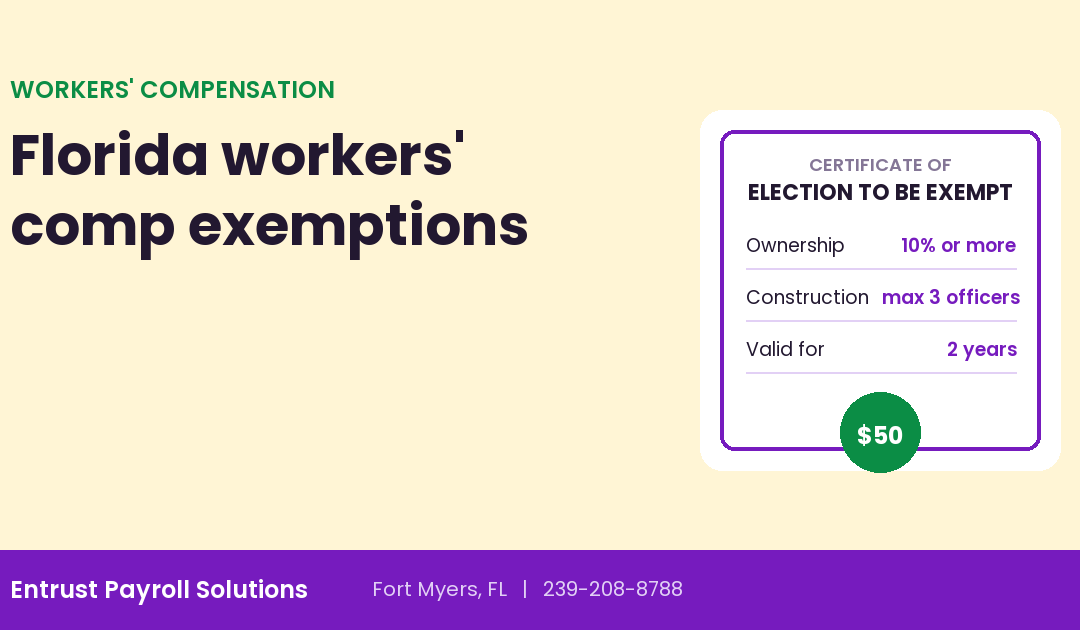
TL;DR: A Florida workers comp exemption lets a qualifying corporate officer, or an LLC member owning at least 10%, opt out of coverage for themselves. Construction businesses can exempt no more than three officers, each owning at least 10%, and pay a $50 fee per certificate, valid for two years. Sole proprietors in construction cannot exempt at all. The exemption never covers your employees.
The Florida workers’ comp exemption is one of the most searched workers’ comp topics in the state, and one of the most misunderstood. Owners assume it exempts their business. It does not. It exempts specific people, usually the owners, and only if they meet the rules for their industry. If you are still working out whether you need coverage at all, start with our guide to whether you need workers’ comp in Florida, then come back here.
What does a Florida workers’ comp exemption actually do?
A workers’ comp exemption removes a qualifying business officer from the definition of “employee” under Florida’s workers’ compensation law. That officer is no longer covered if they are hurt on the job, and they no longer count toward the employee thresholds that require a business to carry coverage. Everyone else on payroll is unaffected.
That second point is why exemptions matter to small businesses. Florida’s workers’ compensation law applies to private employers with four or more employees, or to construction businesses with even one. An owner-operated company with three officers and one employee may be able to exempt the officers and fall below the threshold, while a company of the same size in construction still needs coverage for that one employee.
The trade-off is real. An exempt officer who is injured has no workers’ comp benefits. Health insurance may not cover a work injury either. Talk it through with your insurance agent before you file.
Who qualifies for a workers comp exemption in Florida?
Any officer of a corporation can elect a workers comp exemption in Florida, and the law treats an LLC member who owns at least 10% of the company as a corporate officer. The officer must be listed with the Florida Division of Corporations. Outside construction, there is no cap on how many officers can be exempt.
Those rules come from the definitions section of Florida’s workers’ compensation law, Florida Statute 440.02, which also sets the stricter construction rules below. In practice, most exemptions are filed by the owners of small corporations and LLCs who work in the business themselves.
What does not qualify:
- Employees who are not officers. An exemption is not available to regular staff, no matter what they agree to.
- Sole proprietors and partners in construction. Florida law treats them as employees who must be covered. To exempt, a construction owner has to operate as a corporation or LLC.
- Independent contractors in construction. They are treated as employees for coverage purposes unless they have their own coverage or exemption.
Sole proprietors outside construction are a different case: they are not counted as employees in the first place, and can choose to be covered if they want to be.
The construction exemption: stricter rules
Construction is where most Florida workers’ comp exemptions are filed and where the rules are tightest. No more than three officers of a corporation, or of a group of affiliated corporations, can be exempt. Each must own at least 10% of the stock and be listed as an officer with the Division of Corporations.
The “affiliated” part matters if you own more than one company. Three exempt officers is the limit across the whole group, not three per entity. And because construction businesses need coverage from their first employee, the exemption only removes the owners; the moment you hire, that person must be covered.
Construction in Florida’s law is broader than most people expect: remodeling, roofing, painting, many trades that feel like “repair work.” Our workers’ comp guide explains how far the definition reaches, and our industrial and manufacturing payroll clients often sit close to that line.
How do you get a workers comp exemption in Florida?
To get a workers comp exemption in Florida, the officer files a Notice of Election to be Exempt electronically with the Division of Workers’ Compensation. The notice lists the officer’s name, date of birth, driver license or Florida ID number, and any construction licenses they hold. The Division issues a certificate once the notice is approved.
Before you apply, check the basics:
- The business is registered and active with the Division of Corporations.
- You are listed there as an officer, or as an LLC member.
- You own at least 10% of the company if you are applying under the construction rules or as an LLC member.
- For construction, no more than three officers in the business, or its affiliated companies, will be exempt.
- You have your driver license or Florida ID and any contractor license numbers ready.
The Division runs the application online through its exemption portal, and it also offers a public exemption search, so you can confirm an existing exemption by name or company. General contractors routinely check that search before hiring a subcontractor.
How much is a workers comp exemption in Florida, and how long does it last?
A construction workers comp exemption certificate in Florida costs $50 for each new certificate or renewal. A certificate is valid for two years from its effective date, and both the effective and expiration dates are printed on it. After two years it expires unless the officer renews it.
Those terms are set by Florida Statute 440.05, which governs the election itself. It also allows the exemption to be revoked early, either by the officer or by the Division. The certificate expires at midnight 2 years from its issue date, so put the renewal on your calendar well ahead of that.
A lapsed construction exemption is not a paperwork problem, it is a coverage problem: the officer becomes an employee again, and a construction business with an uncovered employee is out of compliance. The penalties for that are covered in our post on what it costs to skip workers’ comp in Florida.
What an exemption does not cover
- Your employees. Everyone who is not an exempt officer still counts, and still needs coverage once you hit the threshold for your industry.
- Work in other states. A Florida exemption is a Florida election.
- Remote staff. Employees who work from home still count; our post on whether workers’ comp covers remote employees explains why.
- Misclassified workers. Calling someone a contractor does not remove them from the count if the law says they are an employee. See our 1099 vs. W2 guide.
Frequently asked questions about Florida workers’ comp exemptions
How can I check if I am exempt from workers’ comp in Florida?
The Florida Division of Workers’ Compensation offers a public exemption search where you can look up a person or company. Your certificate also shows its effective and expiration dates.
How to be exempt from workers’ comp in Florida?
You must be a corporate officer, or an LLC member owning at least 10%, listed with the Division of Corporations. You then file a Notice of Election to be Exempt electronically with the Division of Workers’ Compensation.
How much is the workers’ comp exemption in Florida?
A construction exemption certificate costs $50, and a renewal costs the same. The certificate is valid for two years from its effective date.
Can a sole proprietor get a workers’ comp exemption in Florida?
Not in construction. Florida treats construction sole proprietors and partners as employees who must be covered. Outside construction, sole proprietors are not counted as employees unless they choose to be covered.
Get your coverage and exemptions right
Exemptions, thresholds and pay-as-you-go premiums are easier to manage when your payroll and workers’ comp talk to each other. Our workers’ compensation service helps businesses in Fort Myers, Cape Coral and across Southwest Florida. Get a free quote or contact me at 239-208-8788.