
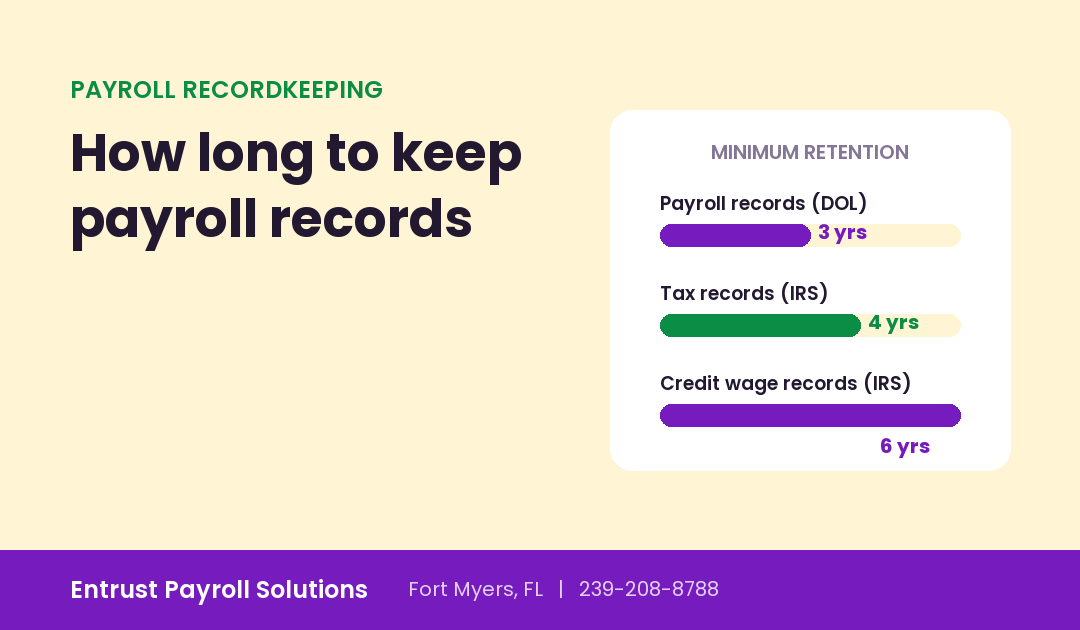
How long to keep payroll records depends on which rule you are following. The Department of Labor requires payroll records for at least three years, and the IRS requires employment tax records for at least four years after you file the fourth-quarter return. Because the periods overlap, a safe habit is to keep payroll and tax files for four full years, and longer for certain credits.
Most owners ask this question when a drawer is overflowing or when an auditor is asking for something. It is easier to settle it once. Below is what each agency says, one table that puts it all together, and a plan you can set up in an afternoon. If you are in the middle of year-end, our year-end payroll checklist shows what to save before the new year starts.
What does the Department of Labor require?
Under the Fair Labor Standards Act, employers must keep payroll records for at least three years. Records used to work out wages, such as time cards, wage rate tables and work schedules, must be kept for two years. All of them must be open for inspection by the Department of Labor.
The Department of Labor spells this out in its recordkeeping fact sheet for the FLSA, which also says the law requires no particular form for the records and that they can be kept at the workplace or in a central records office. Practically, that means you decide how to organize them, as long as they are complete, readable and available when asked.
The three-year rule is the one behind the phrase “FLSA payroll records retention 3 years,” and it is the floor, not the ceiling. If another rule requires longer, the longer one wins.
What does the IRS require?
The IRS says to keep all records of employment taxes for at least four years after you file the fourth-quarter return for the year. They should be available for IRS review. That is longer than the Department of Labor’s three-year payroll rule, so the IRS period usually sets your practical retention schedule.
The IRS describes this on its page for employment tax recordkeeping. The records it lists include:
- Your employer identification number
- Dates and amounts of wage payments
- Employee names, addresses, Social Security numbers and occupations
- Employment dates
- Income tax withholding certificates (Form W-4 and its variants)
- Tax deposit dates, amounts and confirmation numbers
- Copies of the returns you filed
- Records of fringe benefits and expense reimbursements
- Documentation supporting any credits you claimed
The same page adds a longer period for some pandemic-era credits: records supporting qualified sick leave wages, qualified family leave wages for leave after March 31, 2021, and employee retention credit wages paid after June 30, 2021 must be kept for at least six years. If you claimed any of those, do not clear them out on the four-year schedule.
How long should each type of record be kept?
Keep payroll records at least three years, wage calculation records at least two years, and employment tax records at least four years after filing the fourth-quarter return. Records supporting certain sick leave, family leave and employee retention credits should be kept at least six years. In practice, four years covers most of it.
Here is the retention period for payroll records, all in one place:
| Record | Minimum period | Rule set by |
|---|---|---|
| Payroll records | 3 years | Department of Labor (FLSA) |
| Time cards, wage rate tables, work schedules | 2 years | Department of Labor (FLSA) |
| Employment tax records (Forms 941, W-4s, deposits, wage payments) | 4 years after filing the fourth-quarter return | IRS |
| Records supporting qualified sick leave, family leave and employee retention credit wages | 6 years | IRS |
These are federal minimums. I have not found a separate Florida retention period for payroll records that is longer, but I would not read that as permission to purge early: confirm with your accountant if your business sits in a regulated industry, holds government contracts or has ever received a notice. And keep Form I-9 on its own track, since it follows a different retention rule.
What counts as a payroll record?
A payroll record shows what you paid, to whom and when: employee names and addresses, pay rates, hours worked, wages paid each period, deductions, and the tax withholding and deposit records that go with them. Time cards and wage rate tables count too, though their federal retention period is shorter.
Think of it as two piles. The first is the money pile: pay registers, pay stubs or their electronic equivalents, deduction records and tax deposits. The second is the support pile: time cards, schedules and the signed forms that explain why an amount was withheld, like a W-4. The IRS and the Department of Labor care about both, and a missing support record can make a clean payroll look unsupported.
If your pay stubs are a weak point, our post on getting the pay stub right covers what should be on them. And the new hire paperwork checklist for Florida shows which documents start a file in the first place.
Can you keep payroll records electronically?
The Department of Labor says the FLSA requires no particular form for payroll records, and that they must be open for inspection. In practice, paper and electronic copies both work as long as you can produce complete, readable records quickly. Back them up and organize them by year.
A few habits make electronic storage reliable:
- Save year-end reports as PDFs and store them in a folder named for the year.
- Keep a second copy somewhere else, such as a cloud drive or an external disk.
- Limit who can open payroll and personnel files. These contain Social Security numbers.
- Check that you can actually open last year’s files before you need them.
A simple retention plan for a small Florida business
Here is a plan that keeps you on the right side of every rule above without turning into a project:
- One folder per year. Payroll registers, quarterly returns, deposit confirmations, W-2s and W-3s, and 1099s.
- Keep four full years plus the current one. That clears the IRS four-year period with room to spare, and covers the Department of Labor’s three years.
- Mark anything tied to a credit. If you claimed a pandemic-era credit, tag the folder for six years.
- Purge once a year, in January. Remove the oldest folder only if nothing in it is tied to an open audit, claim or dispute. If you are unsure, keep it and ask your accountant.
- Ask your payroll provider what it archives. Any provider, including me, should be able to tell you what it keeps and for how long, and you should still hold your own copy of the year-end reports.
If you run a restaurant, a medical practice or a seasonal business in Fort Myers, Cape Coral or Naples, where staff turnover is high, the file count grows quickly, so set the system up before you need it. Our payroll tax service keeps your filings and deposits on schedule, which makes the tax side of the records far easier to assemble. And if you are weighing whether to keep doing this in-house, our guide on when to outsource payroll is a good place to start.
Frequently asked questions about payroll record retention
What are the federal payroll record retention requirements?
Federal rules set several periods. The Department of Labor requires payroll records for at least three years and wage calculation records for two years. The IRS requires employment tax records for at least four years after you file the fourth-quarter return, and six years for certain credit-related wage records.
What payroll records should be kept for three years?
Under the FLSA, payroll records are kept for at least three years. They show what each employee was paid and when, including names, pay rates, hours and wages. Records used to compute wages, like time cards and schedules, are kept for two years.
How long do I keep time cards?
The Department of Labor says records used to compute wages, such as time cards and piece work tickets, wage rate tables and work and time schedules, should be kept for two years. If you keep them with your tax records, they will be retained longer anyway.
Do I have to keep records longer for pandemic-era credits?
Yes. The IRS says records supporting qualified sick leave wages, qualified family leave wages for leave after March 31, 2021, and employee retention credit wages paid after June 30, 2021 must be kept for at least six years.
Need help getting your records in order?
I would rather help you set this up before an audit letter shows up than after. When you call, you get me, not a ticket. Get a free quote or contact me at 239-208-8788. I work with businesses across Fort Myers, Cape Coral, Naples, Estero, Bonita Springs and Lehigh Acres.